Posts

March 'Manders

Image
After a long month of cold weather in March it was finally time to step back outside in search for amphibians on March 27th. With heavy rains and higher temperatures in the forecast it was inevitable that the salamanders would finally be starting their migrations. Amphibian migrations take place every spring with different species moving at different times. Each species will travel from their overwintering habitat to the vernal pools that fill up with water in the spring from snow melt and rainfall. Usually the earliest arrivals are Jefferson Salamanders who will often enter these pools as soon as there is a large enough gap between the ice and the edge of the water for them to slip under. In the last few days of March I have managed to witness the Jefferson Salamanders migrating through the forest floor, across ice, and swimming and breeding within the vernal pools they occupy. Ambystoma jeffersonianum Ambystoma jeffersonianum Along with these Jefferson Salaman...

February Findings

Image
When the sun comes out and the daily high is 14 or 15C for two days in a row, animals start to come up to enjoy the warmth, despite what month it is. And that's just what happened on February 27th and 28th. I had some free time and the weather was perfect, so I went out to a new location I had heard great things about to go for a hike, enjoy the warm sun, and hopefully see some reptiles and amphibians. I was not disappointed. Unfortunately, the first animal I came across was a deceased Thamnophis sirtalis (Eastern Gartersnake) that appeared to have frozen to death at the base of a tree. Thamophis sirtalis - Eastern Gartersnake. February 27th. But all of the animals to follow were very much alive, even though they were cold and lethargic. I managed to find my first Plethodon cinereus (Eastern Red-backed Salamanders) of the year. And at the same time found my first Hemidactylium scutatum (Four-toed Salamander) of the year, which also marks my first Four-toed Salamander I...

An Early Emergence

Image
2018 started off with some intense weather fluctuations. By mid February we were seeing nights where the temperature would remain positive 5 degrees Celsius or more in the Hamilton-Wentworth Region. And some of these nights had large amounts of rainfall. Although it was only February, I knew that this weather would bring out some early rising amphibians. Particularly the Ambystomid species (mole salamanders). So on February 19th, when the weather was just right, myself and my friend Billy Olds grabbed our flashlights and went out into the night to look for amphibians. When we first arrived on location I was pretty confident that we would find at least 1 or 2 salamanders. But as we walked through the forest across an abundance of ice and snow and past vernal pools that were still completely frozen, that confidence started to diminish. We had even checked the pool where I often see Ambystoma maculatum (Spotted Salamanders) and Ambystma jeffersonianum x laterale (Jefferson x Blue-spot...

An Incredible Week of Ontario Herping (Part 3)

Image
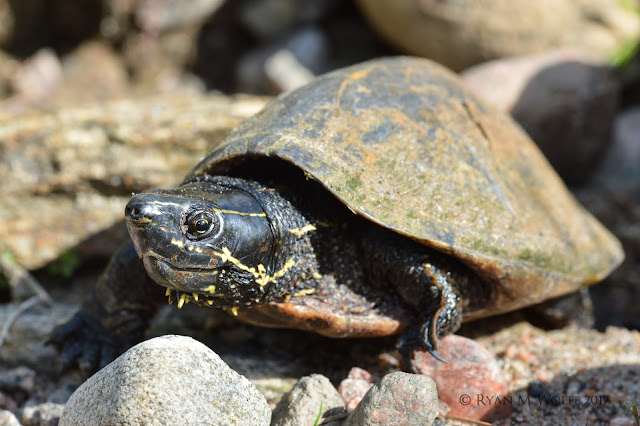
Starting out like any other day, I didn't expect this particular Tuesday to be anything special.  But I'm glad it was. I went the whole morning and early afternoon going about my business for the day. it wasn't until the late afternoon, when I was driving, that I noticed a little lump up on the road ahead. Being at prime nesting time for turtles I knew this was one of these reptiles. At first I thought it was a small female Painted Turtle but when I got up to it I saw that it was something different. It was an Eastern Musk Turtle! I hadn't seen one of these yet this year, so it was great to have this opportunity and even better that I was able to save the individual from oncoming traffic. Eastern Musk Turtle - Ontario  I quickly moved it across the busy road and it went on it's way into the wetland on the other side. Eastern Musk Turtle - Ontario This was a particularly interesting and unique observation. Musk Turtles hardly ever leave the ...

An Incredible Week of Ontario Herping (Part 2)

Image
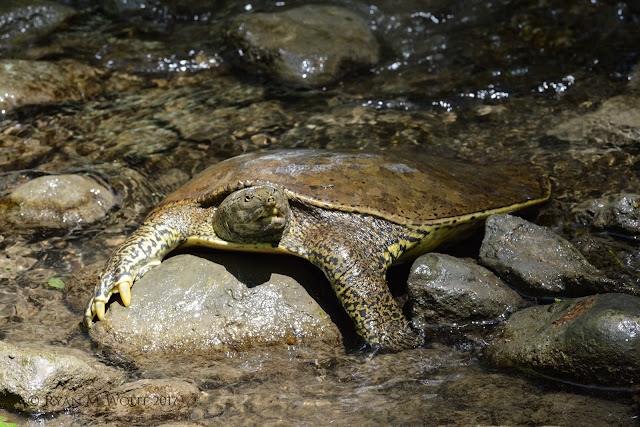
Again, it has been far too long since my last post. Especially considering this is a continuation of it. I apologize to those of you who were expecting it sooner. I guess sometimes life gets busy and you lose track of time! Anyhow, in the last post I left you off ending my trip to Pelee Island where we saw an incredible array of species. With a special highlight being the 3 Blue Racers! If you haven't read the first part I strongly encourage you to go back and read it before this one (here is the link:  https://herpingontario.blogspot.ca/2017/10/an-incredible-week-of-ontario-herping.html ). So now we are off the island, fueling up the car for the 3 hour drive home. Taylor and I get to talking and start discussing places we will be passing on the drive home. And before you know it, we of course have a herp detour planned. We set off to the county of Middle Essex in search for an endangered turtle. A week or so before this, I had previously seen over 13 adult Spiny Softshell ...

An Incredible Week of Ontario Herping (Part 1)

Image
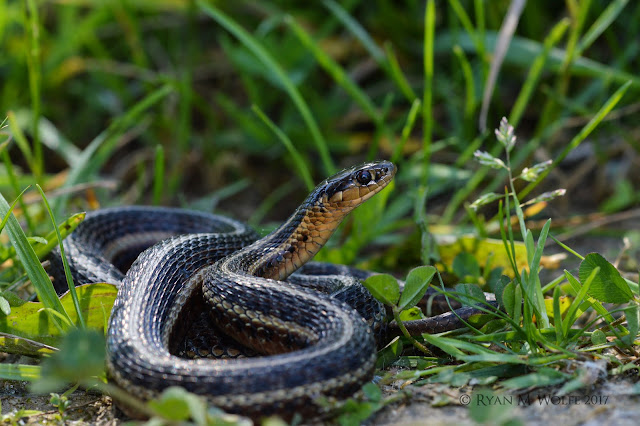
Although the title says "week", this was all really done within 5 days. The best 5 days of my life. DAY ONE: It all started the morning of June 1st on our way down to Ontario's Southernmost point of land, Pelee Island. We had decided to make a pit-stop in the Windsor area while waiting for the ferry. We wanted to search for a small Species at Risk (SAR) snake.. any ideas of which species that may be?! If you said Butler's Gartersnake, you would be correct! Butler's Gartersnake (Thamnophis butleri) This beautiful female was found by my good friend Taylor Kennedy. And not only was she beautiful, she was gravid (pregnant)! Being an endangered snake in our province, we are always happy to see a snake that will, hopefully, go on to produce a new generation. Identification tip: Butler's Gartersnakes have lateral (side) stripes on the third scale row and part of the second and fourth scale rows whereas the Eastern Gartersnakes lateral stripe only touc...